





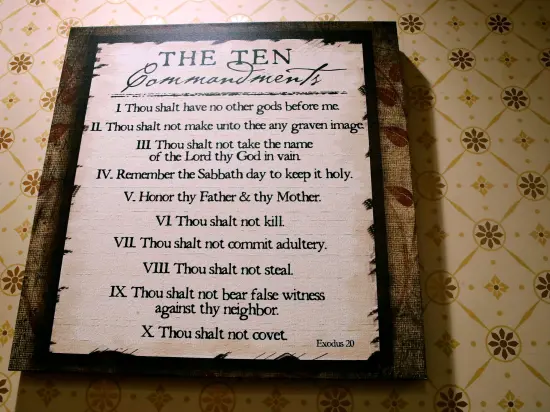
Thou shalt — or shalt not — display the Ten Commandments on public property?
The laws introduced in the Bible's Book of Exodus continue to divide opinion in the United States, where debates over religious freedom and the separation of church and state are resurfacing as the country approaches its 250th anniversary.
Tennessee school boards may now consider whether to display the Ten Commandments on school campuses under a new state law. Any display could be placed alongside "In God We Trust", which Tennessee lawmakers required public schools to display in 2018.
The debate has also resurfaced in Rutherford County, where Murfreesboro resident Wonderland Rogers has questioned why the Ten Commandments have returned to the historic county courthouse despite a 2002 federal court ruling ordering a previous display to be removed.
"Nothing good is going to come from the mixing of religion and government,” Rogers told The Daily News Journal.
“Theocracy is never a good thing, even for people who think it’s all going to be Christian as we’ve seen in the past with the Catholics verses the Protestants or Protestants verses other Protestants. Even the Puritans were in America because they were fleeing religious prosecution from other Christians."
Former Rutherford Republican Mayor Bill Ketron hung the current Ten Commandments display at the Civil War era courthouse. Ketron said he led the county commission in establishing the government building as a local history museum in downtown Murfreesboro during his term from 2018-22.
"There is a state law that says anything in a museum in Tennessee is protected," said Ketron, who's also a former 16-year state senator. He served in the legislature before becoming mayor in 2018.
Previous Ten Commandments part of historical display
A past Ten Commandments that was part of a larger "Foundations of American Law and Government" display won Rutherford County Commission approval in 2002 to be posted in a main first floor hallway of the courthouse.
In addition to the Ten Commandments, the display included copies of the Declaration of Independence, the Bill of Rights of the United States Constitution, lyrics of The Star Spangled Banner, Preamble of the Tennessee Constitution, Mayflower Compact and Magna Carta.
The religious laws came down because of the 2002 federal court order. It came after an American Civil Liberties Union (ACLU) of Tennessee lawsuit to remove the Ten Commandments.
"It is difficult for the Court to reach any conclusion other than that the sole purpose of erecting the challenged display was for the advancement of a religious purpose," the ruling said.
Court order cites religious intent of Ten Commandments display
The court order also mentioned a 1999 county commission resolution to display the Ten Commandments based on the "great Biblical history of Tennessee" in an attempt to "petition the God of Heaven to preserve the peace" and "beg His continued protection and alleviation of ills which come to those who forget Him and His law."
"There is no secular purpose discernible from the face of the resolution," the court order said.
"Defendants are hereby ORDERED to remove the 'Foundations of American Law and Government' display from the Rutherford County Courthouse immediately or alternatively, to remove the Ten Commandments from the display immediately," the federal court ruled.
The county government, led by former Democratic Mayor Nancy Allen in 2002, responded to the court order by removing the Ten Commandments but keeping the rest of the "Foundations of American Law and Government" display.
Former Mayor Ketron hangs new Ten Commandments display
Ketron contends that Rutherford County should keep The Ten Commandments on display. He contacted The Daily News Journal recently after state legislators approved the option for public school districts to display the biblical laws at campuses.
The former Republican mayor said he was unable to find the previous framed copy of the Ten Commandments that once hung in the courthouse.
So Ketron found a different version and had them framed and hung in Room 205.
Ketron also moved the other "Foundations of American Law and Government" documents from the first floor to Room 205, which is used for public meetings on the second floor.
Ketron says Ten Commandments protected display in museum
Since his mayoral term ended in 2022, Ketron has served as a government relations liaison for Middle Tennessee State University to advocate for MTSU funding from state and federal government officials. He graduated in 1976 from the Murfreesboro university with majors in political science and history.
Ketron also serves as chairman of the Tennessee Monuments and Memorials Commission after accepting appointment from Lt. Gov. Randy McNally, R-Oak Ridge, according to a Tennessee Department of Environment and Conservation website.
"So any time somebody wants to take one down or move it, it has to come before my committee at the state level," Ketron said.
The former lawmaker has a different perspective on First Amendment restrictions on the government's role with religious displays than Thomas Jefferson, the country's third president and crafter of the Declaration of Independence and Virginia's Statute for Religious Freedom, according to the website for Monticello, Jefferson's historic home.
"Politically, Jefferson believed that the new nation required complete religious freedom and separation of church and state," the Monticello website says, noting that Jefferson asserted that any government effort to control religious beliefs was “tyranny over the mind of man.”
Plaintiff upset that Ten Commandments returns to courthouse
The re-emergence of the Ten Commandments at the Rutherford County Courthouse upset Steve Cates, a Murfreesboro resident who was among the local plaintiffs in the ACLU lawsuit against the County Commission.
"Those who want to post a 'Ten Commandments' never can tell me which version they want to post," said Cates, a retired teacher, whose tenure includes 31 years as a founding faculty member at Riverdale High School in 1972 for science, government, economics and U.S. History courses.
Cates is also an organizer for the International Folkfest that's been in Murfreesboro for 44 years, as well as Rutherford County's Cripple Creek Cloggers.
"In 2026, and in our multicultural county, that anyone would want to use government to push one faith group is totally unbelievable," Cates said.
"I'll never understand it. I was raised on Cripple Creek and am a Baptist by birth and selection. If, in my 86th year, I can understand it, anyone should be able to do so. If this trend continues, I am sorry I will not be here when the main religion in our county is Muslim or Hindu or Jewish or Spanish-speaking Catholic and public-school teachers lead their students in these prayers."
Cates and The Daily News Journal (DNJ) have tried unsuccessfully to get a response from the ACLU since the Ten Commandments have returned to the Rutherford County Courthouse.
Free speech expert offers insight
National Free Speech Center Director Ken Paulson questions if the Ten Commandments should be on display at public schools.
"Any application of common sense would find the Ten Commandments to be a religious document, ordered to be posted in taxpayer-supported public schools by public officials using their power to advance their own religion," Paulson told the DNJ.
"How can that not be regarded as using government power to promote one faith over others? A child raised in a non-Christian household will be required by law to sit in a classroom facing an icon of faiths that are not his own. That flies in the face of American values.”
State governments would be well-advised to go slow while this issue is sorted out by the courts, probably by the U.S. Supreme Court, said Paulson, whose center office is based at MTSU.
Courts have allowed Ten Commandments for secular, historical purposes
In recent years, courts have allowed the display of the Ten Commandments if the purpose is secular and part of a broader display showing historic documents and how they helped shape America’s laws and values, said Paulson, who's also a former editor in chief at USA Today.
"In other words, the display had to be educational and not intended to advance a specific religious belief," Paulson said.
The U.S. Fifth Circuit Court of Appeals ruled this spring that Texas could require every public classroom to put up a poster with the Ten Commandments, Paulson said.
"It was a surprising decision, even for the most consistently conservative appellate court in the country," Paulson said.
"The court reasoned that when the Bill of Rights was adopted in 1791, no one would have viewed such a display as an establishment of religion. The Texas ruling doesn’t apply to Tennessee schools, but it has undoubtedly emboldened some officials to proceed where their lawyers might previously have urged caution."
Rogers, the Murfreesboro resident who questions the Ten Commandments display at the Rutherford County Courthouse, also noted that the biblical laws can vary.
“It’s not going to stop," said Rogers, who will be majoring in art and journalism this fall at MTSU.
"Everybody is going to think that their version is correct, which is why we need secularism and separation of church and state. And that is why the Ten Commandments concern me.”
Reach reporter Scott Broden with news tips or questions by emailing him at [email protected]. To support his work with The Daily News Journal, sign up for a digital subscription through the website dnj.com.
USA TODAY Network via Reuters Connect