


Christians in Myanmar are facing worsening “systematic persecution” under the country’s military regime, according to leading Christian politician and humanitarian Dr Sasa.
Speaking to Premier Christian News about conditions in Chin State, one of the country’s poorest regions, he said: “They raped women. They torture our parents. They destroyed crosses… persecution [is] happening across the Christian regions.”
He added: “If you are Chin and Christian… you don’t get education, you don’t get healthcare… we are like second-class citizens.”
Dr Sasa warned that many attacks go unrecorded because churches are not officially registered. “They destroy it… and there’s no record of that church,” he said, describing what he called “systematic persecution”.
The comments from the medical doctor and politician come after Myanmar’s military-backed parliament reconvened last week following an election widely criticised as a sham.
The vote has handed overwhelming control to the military and its allies, who now hold nearly 90% of seats across both chambers. This is despite the armed forces controlling only a fraction of the country, with large areas held by rebel groups.
Myanmar has been under military rule since a 2021 coup, with the armed forces accused of widespread abuses targeting civilians, including bombing churches and Christian villages during the ongoing conflict. International monitors say millions have been displaced, with religious minorities among those most affected.
Dr Sasa described the current political system as illegitimate: “These are the generals who killed more than 8,000 people… destroyed more than 340 churches.”
He added: “They want us to be uneducated… to be divided… to be poor.”
Dr Sasa was born in what he describes as a “jungle”, where there is no hospital, school or electricity. After witnessing the deaths of friends and neighbours in childhood, he said the “pain became a passion in my life”, driving him to pursue medicine and serve his people.
He went on to train as a doctor internationally before returning to Myanmar, where he helped build community healthcare systems and trained more than 1,000 local health workers.
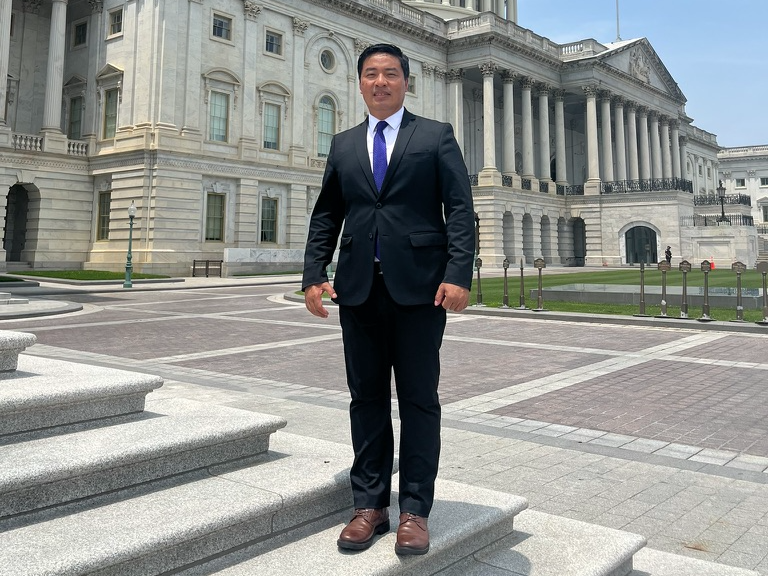
His work later led him into politics and international advocacy, despite his reluctance: “I didn’t want to be a politician… but I believed I could serve my people.”
The day he was due to be announced as a senior figure in government was 1st February 2021, the same day the military coup took place, marking a moment of intense violence and tragedy that the country still feels today.
“I looked outside the window around 5 am. I saw the armed forces. They had weapons, destroying our buildings and our streets. I wish it were a dream,” he said.
“I had to escape the valley of death, as I call it. Since then, almost 8,000 civilians have been killed by the military regime, and more than 22,000 political prisoners have been arrested, including Aung San Suu Kyi, our leader.
“Several of my colleagues have been executed, and now we are talking about five million people homeless and displaced, and more than 21 million people in Burma who need lifesaving assistance.
“So all of that is the consequence of this man-made crisis.”
After the coup, parliament elected Dr Sasa as Myanmar’s special envoy to the United Nations, becoming a leading international voice for the country. Out of that moment, the National Unity Government was formed, in which he served as a minister. The group is widely viewed as Myanmar’s legitimate government and now largely operates in exile.
In December, Dr Sasa confirmed a new chapter in his work. “Serving the courageous people of Myanmar… has been the greatest honour of my life,” he said. “Though this chapter closes, my commitment to our nation continues with even greater purpose.”
He announced the launch of the Institute of Peace and Federal Democracy, aimed at strengthening local governance, amplifying Myanmar’s voice internationally and supporting a transition to democracy.
“I will not rest until the people of Myanmar are free. We must never give up,” he said.
He now raises global awareness of the atrocities in the country and of efforts to bring about change, including by addressing the US Congress and the UK Parliament. “We are asking everybody not to support them [the military regime]… because that would be like engaging with a criminal gang,” he said.
Despite the ongoing crisis, Dr Sasa emphasised the importance of faith, calling on Christians worldwide to pray.
“We believe this is a spiritual battle,” he said. “God can change hearts.” He added that Myanmar’s future remains one of hope: a nation that can one day “become the light in the darkness.”