


Francis has so far refrained from speaking out about Asia's worst humanitarian crisis in decades, out of deference to his Burmese hosts who consider the Rohingya "Bengalis" and do not recognize them as an ethnic group.
The Vatican has defended Francis' silence, saying the pope wants to "build bridges" with the predominantly Buddhist nation.
Vatican spokesman Greg Burke said Francis took the advice given to him by the local Catholic Church seriously, which urged him to toe a cautious line and not even refer to the "Rohingya" by name during his trip.
"You can criticise what's said, what's not said, but the pope is not going to lose moral authority on this question here," Mr Burke told reporters on Wednesday.
But human rights groups and Rohingya themselves have expressed disappointment that Francis, a tireless and fearless advocate for refugees and the world's most marginal, has refrained from condemning what the UN has said is a textbook case of "ethnic cleansing."
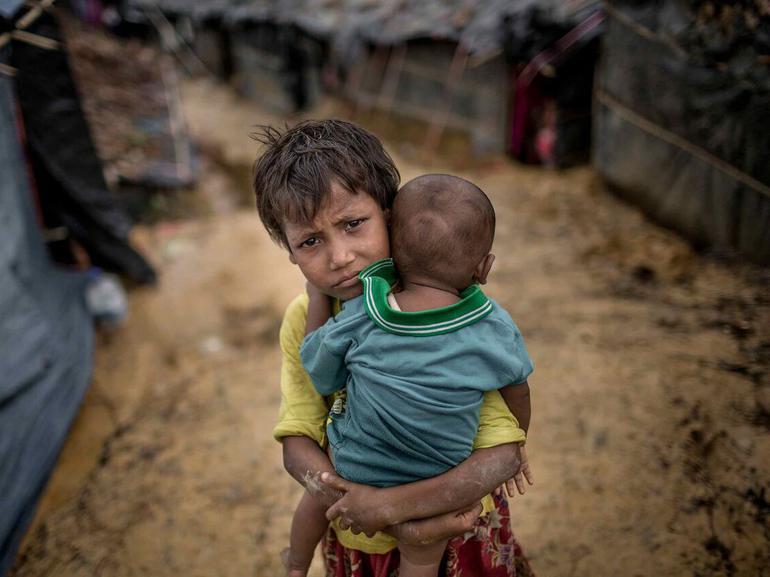
Rohingya have faced persecution and discrimination in Burma for decades and are denied citizenship, even though many families have lived there for generations.
The situation grew worse in August when the army began what it called clearance operations in northern Rakhine state following attacks on security positions by Rohingya militants.
More than 620,000 Rohingya have since poured into refugee camps in neighbouring Bangladesh, where they have described indiscriminate attacks by Burmese security forces and Buddhist mobs, including killings, rapes and the torching of entire villages.
On Wednesday, Burmese Bishop John Hsane Hgyi suggested that reports of atrocities being committed against the Rohingya were not "reliable" or "authoritative," and that those who criticised Burma's response to a complex situation should "go into the field to study the reality and history" to obtain "true news".
The government has barred independent groups from travelling to northern Rakhine state.
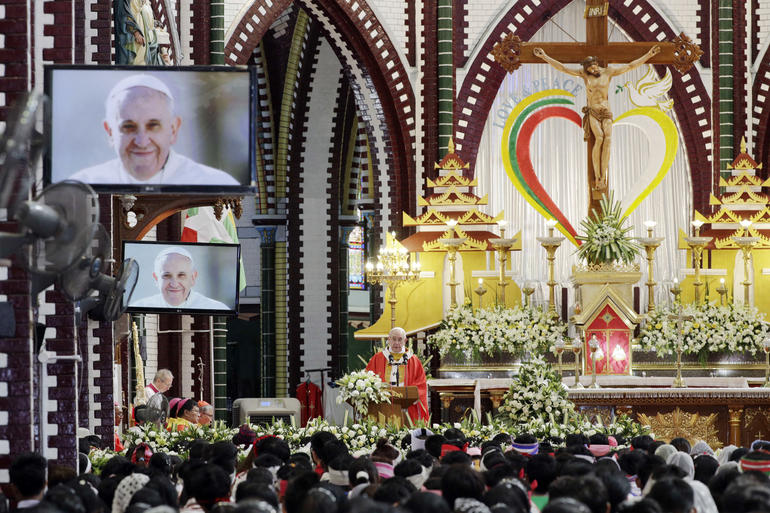
In his final event in Burma, Francis celebrated Mass in Yangon's St. Mary's Cathedral for young Catholics.
The young worshippers, many dressed in the traditional clothing of their ethnic groups, leaned out to touch or kiss Francis' hand as he slowly walked by.
During the Mass, Francis told them to not be afraid to make their voices heard.
"Do not be afraid to make a ruckus, to ask questions that make people think," he told them. "Make yourselves heard."