





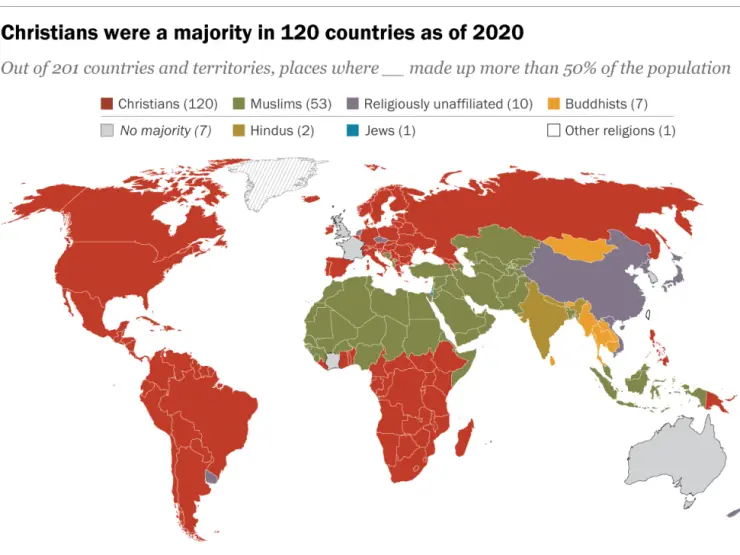
The number of countries where Christians make up more than half the population has dropped, according to a new report from the Pew Research Center.
Between 2010 and 2020, four countries, including the UK, Australia and France, lost their Christian-majority status, as more people in those countries now identify as having no religion.
Christianity remained the largest religion in 120 out of 201 countries and territories as of 2020, but that’s down from 124 a decade earlier.
The drop is linked mostly to people leaving the Christian faith and an increase in those identifying as atheist, agnostic or "nothing in particular".
Speaking to Premier Christian Radio, Yunping Tong, senior researcher at the Pew Research Center, said: "Only two categories grew as a share of the global population: Muslims and the religiously unaffiliated. But the reasons for their growth are quite different."
She added: "Muslims grew fast because they tend to be younger and have more children. The unaffiliated group, however, isn’t growing through birthrates but through people, especially Christians leaving the religion they were raised in."
In the UK and France, no religious group now holds a majority. Uruguay, the Netherlands and New Zealand have become majority non-religious nations.
Globally, Christians remain widely spread, making up the majority in more countries than any other faith. But Tong noted a striking trend, stating that: "For every one person who joined a religion after being raised without one, about three left the religion they were raised in."