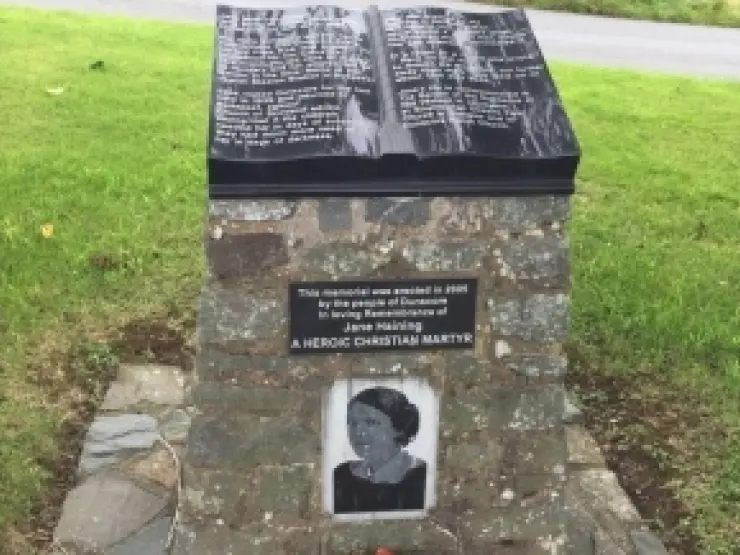





Church of Scotland missionary Jane Haining, who died in Auschwitz after choosing to stay with the children in her care during the Second World War, has been remembered in a tribute at the Scottish Parliament.
Members of the Scottish Parliament (MSPs) said they hoped her example would encourage people to “confront prejudice, persecution and hatred”.
Born in Dumfriesshire in 1897, Miss Haining moved to Hungary in 1932 to become matron of the Scottish Mission School in Budapest.
When war broke out in 1939, the Church of Scotland advised her to return to Scotland. But she chose to stay and continue caring for her pupils, many of whom were Jewish.
She said: “If these children need me in days of sunshine, how much more do they need me in days of darkness?”
Miss Haining was arrested after Germany occupied Hungary in 1944. She told the children she would “be back by lunch”, but was deported to Auschwitz, where she died two months later, aged 47.
Earlier this year, a plaque commemorating her was unveiled at the Auschwitz-Birkenau Memorial and Museum.
A cross-party motion at Holyrood said the Scottish Parliament “remembers the life, courage and sacrifice of Jane Haining” and recognised the care she gave to Jewish and Christian girls at the school.
It also “welcomes the addition of her name to a memorial wall at Auschwitz-Birkenau, ensuring that her story will continue to be told to future generations”.
The motion “believes that her life stands as an enduring example of Christian service, compassion, moral courage and the refusal to abandon others in the face of persecution”.
It said her example had particular resonance at a time when antisemitism and hatred reportedly continued to threaten Jewish communities around the world.
A Church of Scotland spokesman described Miss Haining’s life as “a fine example of Christian service over self-interest”.
He said it was “wonderful” that her life had been recognised by MSPs.